
One day in Ortigia: a walking itinerary, without rushing
Market in the morning, Duomo and square around midday, seafront and the Fountain of Arethusa in the late afternoon. The rest you choose by mood. Be careful with Castello Maniace: the opening hours we found contradict each other, so do not make it the fixed point of your day.
- Area
- Island of Ortigia, Syracuse
- Duration
- One day
- Getting around
- On foot
- Best moments
- Market in the morning, seafront at sunset
- Indicative costs
- Castello Maniace about 5 EUR (indicative average), the rest is walking
In this article
Ortigia is small, and that is exactly why it is easy to get wrong: you cross it in a rush trying to see everything and leave feeling you have not really looked at it. This itinerary does the opposite. Few stops, an order that makes sense and room to pause.
- MorningOrtigia market
The starting point: arrive early, taste standing up and leave before the crowd.
- Late morningDuomo and square
The Greek temple inside the Baroque cathedral, and five minutes on the square.
- LunchSide streets
Two blocks from the square are enough to change quality and prices.
- Early afternoonInner streets and the Giudecca
Without a plan, keeping an eye out for guided visits.
- Late afternoonFountain of Arethusa and seafront
As far as Castello Maniace, in the low light.
What time are you in Ortigia?
Getting there#
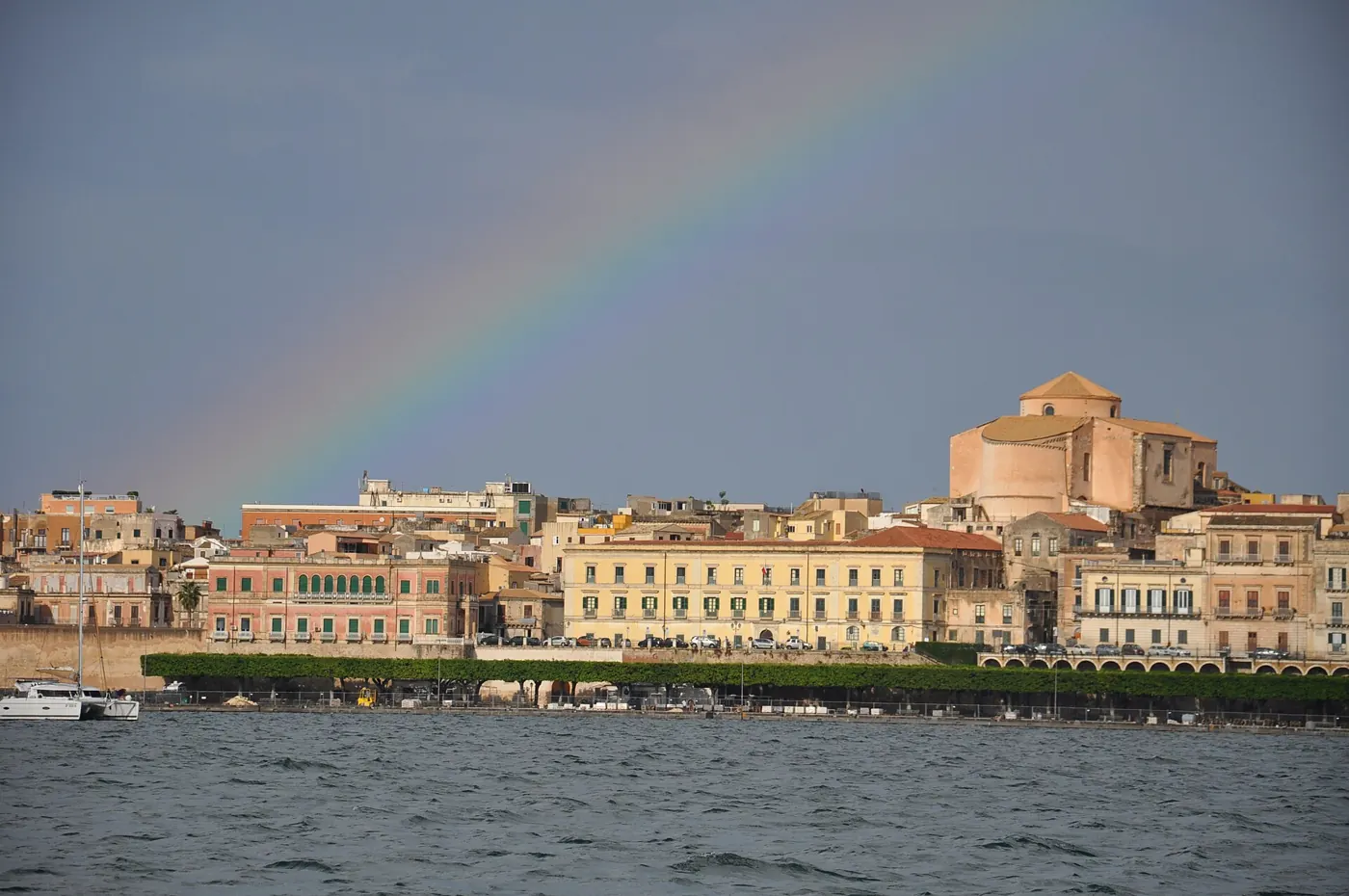
Ortigia is the island that forms the historic centre of Syracuse: according to Italia.it it measures a little over one square kilometre and is linked to the city by two bridges, Ponte Umbertino and Ponte Santa Lucia. From Catania the simplest way is the train to Siracusa. Two timetable pages we read do not agree on the details: one lists 33 trains, the first at 6:06 and the last at 21:29, with journeys between 1h07 and 1h23; the other lists 12 direct trains, from 10:39 to 20:20, with an average of 1h18 and a minimum of 1h05, a train ticket from about 9 EUR and a bus from about 5 EUR (indicative averages). The gap probably depends on the day each page was captured: check the real timetable the evening before.
If you plan to arrive by car, remember there is a restricted traffic zone (ZTL) across the whole island. The page we read, last updated in 2020 and therefore to be taken with caution, lists three camera gates (Santa Lucia, Via Vittorio Veneto, Via dei Mille) and different hours for summer and winter, with tighter restrictions at weekends and in the evening. Hotel and B&B guests enter with a pass issued through their accommodation. For a single day it is not worth it: arrive by train, or leave the car outside and cross on foot. Before you move, check the current rules on the Municipality of Syracuse website and on the road signs.
The right day: why a Friday helps#
Three pieces the sources let you line up: the market, according to Italia.it, runs on weekday mornings behind the Temple of Apollo; the Duomo is listed open every day from 7:00 to 20:00; the Fountain of Arethusa is listed open Friday to Sunday from 10:00 to 13:00 and closed Monday to Thursday. The only day when all three are true is Friday. It is not an official rule and openings change, but it is a good reason to pick a Friday if you are flexible. For Sunday we found no confirmation that the market takes place.
Morning: the market#
Ortigia's market is a good starting point: it runs in the morning and it is where you immediately grasp the island's atmosphere. The liveliest stretch is on Via Emmanuele de Benedictis, according to a food guide we read, with peppers in oil, spices, olives, seasonal fruit and fish that the stalls cut to order. We did not find precise hours on a reliable source, so we do not write them. Arrive early, taste something standing up and leave the stalls before they get crowded. If you are curious about the Catania fish market, read our guide to the Catania fish market and what to eat in Catania.
Late morning: Duomo and square#
Syracuse Cathedral is built around the remains of a Greek temple dedicated to Athena: the Doric columns are still visible in the side walls. According to Italia.it the temple was commissioned in 480 BC by the tyrant Gelon after the victory over the Carthaginians, was turned into a church in the 7th century by Bishop Zosimo, and the Baroque facade dates from the 18th century. It is a rare example of centuries layered in the same building. The same page lists daily opening from 7:00 to 20:00 and does not mention a ticket. The square in front, with its facade, is worth five minutes before moving on. If you want a second temple, the Temple of Apollo, on Largo XXV Luglio, dates from the early 6th century BC and is described as the oldest Doric temple in Sicily: over time it has been a church, a mosque and a barracks. You see it from the street and you pass by without a ticket.
Lunch without hurry#
Ortigia lends itself to long lunches. Avoid trattorie with a tourist menu at the door and look for the side streets: two blocks from the square are enough to change quality and prices. We do not name specific places because we did not verify any address and would rather not invent them.
Early afternoon: the inner streets#
Let yourself get lost in the maze of lanes. In the Giudecca area you find traces of the Jewish presence in Syracuse: the best-known case is a ritual bath (mikveh) under a palazzo on Via Alagona, about 18 metres underground. On its date the sources disagree: one gives it as discovered in 1989 and dating from the 6th century AD, another as discovered about twenty-five years before a 2021 article and closed towards the end of the 15th century. Both say it can still be visited, but neither gives hours or prices: if guided visits interest you, check days and times in advance. If you would rather have a museum, Palazzo Bellomo houses the Galleria Regionale with works from the 12th to the 18th century, including Antonello da Messina's Annunciation; we did not verify its hours.
Late afternoon: Fountain of Arethusa and seafront#
The Fountain of Arethusa is a freshwater spring a few steps from the sea, tied to the myth of the nymph Arethusa and the river god Alpheus. The semicircular basin with papyrus dates from 1843 and the water is now brackish because of seawater infiltration. Italia.it lists it open Friday to Sunday, 10:00-13:00: that does not coincide with sunset, so do not count on getting in at last light. We could not check the operator's own page, so if it is a fixed point for you, ask first. From here the walk along the sea leads to Castello Maniace, at the tip of the island. The best moment is when the light drops.
On the Castello the sources do not agree. Italia.it: Monday 8:30-13:30, Tuesday to Saturday 8:30-16:30, Sunday closed. Museionline: Tuesday to Sunday 8:30-13:00, Saturday until 18:00, Monday 13:00-18:00. The measurements differ too: about 58 metres a side for one source, about 51 for the other. One page gives the ticket as 5 EUR full and 2.50 EUR reduced (indicative average). All you need to know: in the late afternoon the castle may already be closed, but the walk around it and the view from outside remain the real reason to come all the way. It was commissioned by Frederick II in 1239 and designed by Riccardo da Lentini, according to Italia.it.
Want a route like this, ready-made and adapting to the weather?
Be among the firstWhat to leave out#
- Too many museums in the same day: one, well chosen, is enough.
- Out-and-back trips: follow a loop.
- The idea of "having seen everything": Ortigia gets better with every return.
- Castello Maniace as an obligation: see it from outside if you cannot get in.
Common mistakes#
- Arriving in the afternoon and missing the market.
- Planning sunset at the Fountain of Arethusa and finding it open only in the morning.
- Driving in: the ZTL exists, and fines are not a legend. We did not find the amount, so we do not write it.
- Looking in Ortigia for the Caravaggio painting: according to Finestre sull'Arte, the "Burial of Saint Lucy" has not been at Santa Lucia alla Badia since 2020 and returned to Santa Lucia al Sepolcro. Check where it is shown before you add it to the list.
Accessibility#
The streets are largely pedestrian, but we found no verified information on the paving or on the accessibility of individual monuments. The mikveh is reached by 58 steps according to one source, so it is not suitable for anyone with mobility difficulties. People with a disability permit can enter the ZTL, according to the page we read, but must notify the municipal police.
If you have another day#
If you are in the area, also see what to do in Catania when it rains: it is the city many people start from to get here. Syracuse and Pantalica have been listed together as UNESCO World Heritage since 2005; the Pantalica necropolis is about 40 km away, a different day. To think through how to build your own plan, read how to use artificial intelligence for itineraries.
If the weather changes#
In the rain, the itinerary is rewritten: the Duomo and a museum take the place of the seafront, and the market slides to the next day. It is the kind of decision UNNIVAI wants to make automatic. If you are interested, join the waitlist.
Verification note. Data read on 29 October 2026 on the pages listed in the sources (Italia.it, UNESCO Italy, Museionline, Finestre sull'Arte, Balarm, a 2020 ZTL page, two train timetable pages). Where sources disagree (Castello Maniace hours and size, the mikveh date, train times and duration) we say so. We did not verify the hours of the market, the Giudecca or Palazzo Bellomo, nor any lunch spots; the ZTL rules come from a 2020 page. Prices are indicative averages: opening hours and days change, so check the official sources before you go.
Frequently asked questions
How long do you need to see Ortigia?
One day is enough for the main stops on foot. The island is a little over one square kilometre and the stops are close together. With half a day you have to choose between the Duomo, the market and the seafront.
Can you visit Ortigia on foot?
Yes. The island is small and linked to the mainland by two bridges, Ponte Umbertino and Ponte Santa Lucia. A restricted traffic zone covers the whole island, so comfortable shoes matter more than any vehicle.
What is the best time to go?
Morning for the market and quieter streets, late afternoon for the seafront and the light on the sea. To line up the market and the Fountain of Arethusa, the sources we read point to a Friday: the market is described as a weekday-morning affair and the Fountain as open Friday to Sunday.
How do you get to Ortigia from Catania?
By train from Catania Centrale to Siracusa: the pages we read give roughly 1h05 to 1h23 of travel and 12 or more trains a day. Buses also run. Times and prices change, so check on the day.
How much does it cost to visit Ortigia?
Walking costs nothing. Among the documented tickets is Castello Maniace, about 5 EUR full and 2.50 EUR reduced according to one page (indicative averages). We found no verified prices for the other stops.
Official sources
Be among the first.
Tell me where you want to go: I will write when UNNIVAI reaches your city. No newsletter before that.