
What to eat in Naples, in the order of the day
Breakfast with coffee and a sfogliatella, a fried pizza mid-morning, a pizza a portafoglio with a frittatina or a crocchè at lunch, a cuoppo or a babà in the afternoon, a proper sit-down pizza in the evening. About €20-30 per person (indicative) covers the full round. Prices and closing days change from place to place: check before you go.
- Area
- Historic centre of Naples (Spaccanapoli, Via dei Tribunali, Via Toledo, around Stazione Centrale)
- Duration
- A day of tastings, from breakfast to after dinner
- Indicative budget
- About €20-30 per person for a day of tastings with a sit-down pizza (our estimate from the averages we read, drinks not included)
- Getting around
- On foot, a few hundred metres between one tasting and the next
- To check
- Closing days, evening queues and prices, which vary from place to place
In this article
- What do people eat for breakfast in Naples? Sfogliatella and coffee
- What about mid-morning? Fried pizza
- At lunch: pizza a portafoglio, frittatina and crocchè
- In the evening: oven-baked pizza and what STG means
- And after dinner? Babà, fiocco di neve, ministeriale
- What to leave out
- If you have another day
- If your day changes
In Naples you can eat at any hour, but not everything suits every hour. The sfogliatella belongs to the morning, fried pizza wants to come straight from the oil, oven-baked pizza is an evening order, and a babà closes any day well. This guide puts the tastings in order, says roughly what they cost, and where the sources disagree it says so.
- BreakfastCoffee and a sfogliatella
Riccia or frolla: try both if there are two of you. It generally costs a couple of euros.
- Mid-morningFried pizza
Filled with ricotta, pork cracklings and pepper: eat it straight out of the oil.
- LunchPizza a portafoglio and a frittatina
A margherita folded in four and a pasta frittata: two tastings for a few euros.
- AfternoonCuoppo or mixed fry
The paper cone of fried things is eaten while walking: crocchè, zeppole, rice balls.
- EveningSit-down pizza
Marinara or margherita, the two classics: arrive early to avoid the queue.
- After dinnerBabà, fiocco di neve or ministeriale
A sweet to finish: it depends on which pastry shop you pass.
What do people eat for breakfast in Naples? Sfogliatella and coffee#
Start with a sfogliatella, and two words are needed right away. The riccia is the shell-shaped one, made of very thin layers and crisp; the frolla is round, smooth and softer. According to Lost in Food the filling is the same: a cream of ricotta, semolina, eggs and sugar, with candied fruit. Naples Insider confirms the two kinds and says people argue about them without ever settling it: the most useful thing is to taste both.
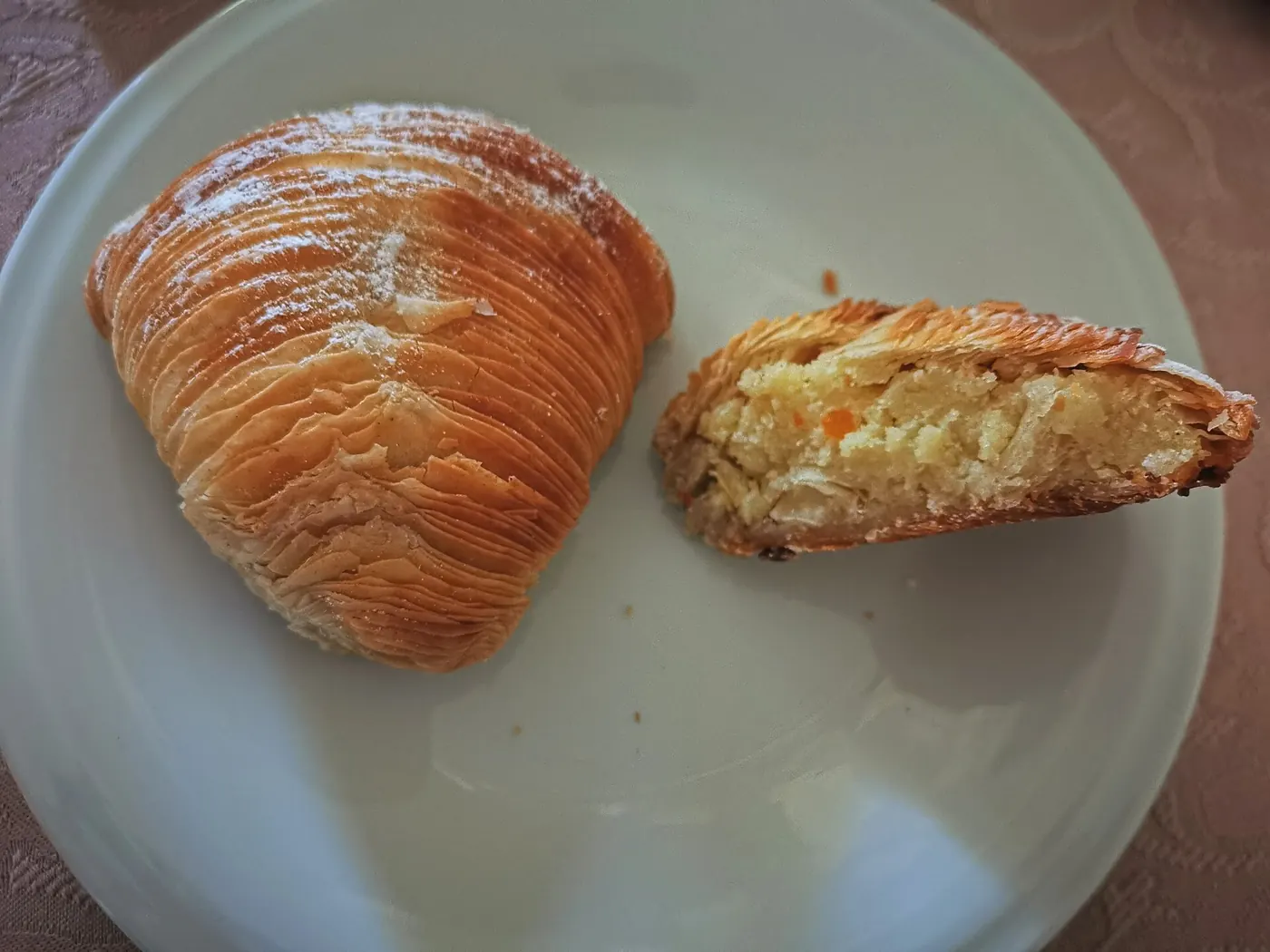
As for history, the sources tell two versions that do not coincide. Lost in Food says the original recipe goes back to 1600 and was born in the convent of Santa Rosa on the Amalfi Coast, and also says a famous pastry shop on Via Toledo claims to have invented it first. Those are stories, not documents, and we report them as such. As for where to go, the Viaggi Pop guide picks Antico Forno delle Sfogliatelle Attanasio, near the central station, for its own tours; Naples Insider also names Scaturchio and Pintauro and warns that at the best-known places you end up queuing. Lost in Food adds that Pintauro is usually closed in August, an undated remark, so check it.
What about mid-morning? Fried pizza#
It is the right moment, says the Viaggi Pop guide: after a bit of walking, around 10:30. The AVPN rules (the association that protects the Verace Pizza Napoletana) describe fried pizza as a disc of dough stretched by hand, thin (about 2-3 mm), either closed into a half-moon (fried calzone) or round, cooked in oil at about 175 °C. The classic filling is ricotta, provola or fiordilatte, Neapolitan salami or pork cracklings and pepper; there is also the montanara, with fiordilatte, tomato and basil.
Two places come up in different sources. Viaggi Pop proposes La Masardona and the counter of Zia Esterina Sorbillo on Toledo; Lost in Food recommends Zia Esterina Sorbillo, next to Sorbillo on Via dei Tribunali, where it says there is a takeaway-only shop and so no two-hour queue. Mind one detail: for La Masardona, Viaggi Pop gives an address on Via Giulio Cesare Capaccio, while Lost in Food speaks of Piazza Vittoria. The two sources disagree, so look up the current address before you go. One practical tip we take from both: fried pizza is eaten right away, and the oil soaks the paper, so bring tissues.
At lunch: pizza a portafoglio, frittatina and crocchè#
The pizza a portafoglio is Naples' answer to a quick lunch: a smaller takeaway margherita, folded in four. According to Naples Insider it costs around €3, and it is the same idea the European specification expresses when it says the pizza should be easy to fold «a libretto» (like a book). Lost in Food reports that a pizza a portafoglio plus a fried pizza at a takeaway shop cost €6 in total; the figure is not precisely dated and should not be taken as a guarantee.
Next to it, a frittatina di pasta: it started as an anti-waste solution with the previous day's leftover pasta, fried with egg and other ingredients, and according to Naples Insider it costs around €3. The potato crocchè is the fried croquette of potato and stringy cheese, between €1 and €3 in the same guide. If you want everything at once, order a cuoppo: the paper cone of mixed fried things (crocchè, frittatine, zeppole, rice balls, sometimes battered vegetables) is eaten while walking. Viaggi Pop suggests a mixed fry in mid-afternoon, when the smell of the fry shops brings back the hunger.
In the evening: oven-baked pizza and what STG means#
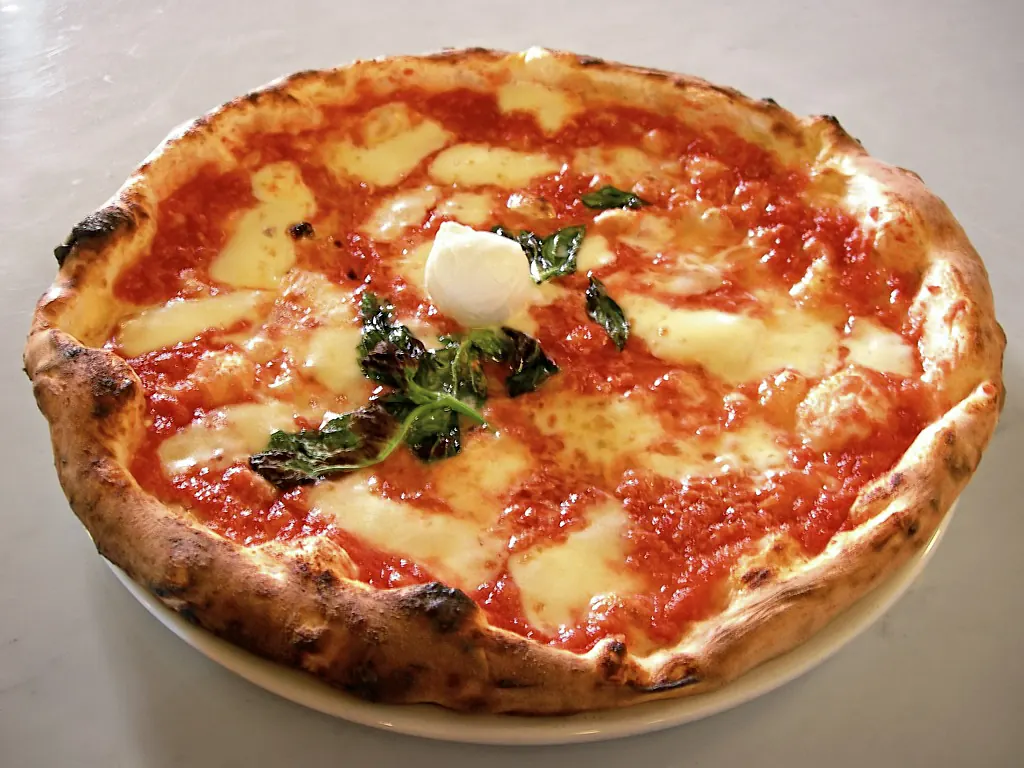
In the evening the register changes. First a word about labels: «Pizza Napoletana STG» is a Traditional Speciality Guaranteed registered by Regulation (EU) No 97/2010. The attached specification sets a diameter of no more than 35 cm, a raised rim of 1-2 cm, a thin centre, dough balls of 180 to 250 g, baking only in a wood-fired oven at about 485 °C for 60-90 seconds, and bans the rolling pin and the disc press. The listed ingredients are soft wheat flour, yeast, water, tomatoes (peeled or cherry), salt and extra-virgin olive oil, with garlic, oregano, basil and Mozzarella di Bufala Campana PDO or Mozzarella TSG.
Here two sources do not match. The AVPN rules (the English version is a 2024 file) also admit certified gas or electric ovens and give the centre at about 0.25-0.30 cm (the European text says 0.4 cm); for total fermentation they give 12 to 24 hours, while the European text describes two stages, one of 2 hours and one of 4 to 6. Nobody is wrong: they are two documents with different purposes, one European, one from the association. The practical outcome is that a pizzeria can belong to the AVPN, make an excellent product and not follow the European label to the letter.
On history, the EU text says the marinara goes back to 1734 and the margherita to the period 1796-1810, offered to the Queen of Italy on her visit to Naples in 1889 for the colours that recall the flag. Lost in Food tells instead that in 1889 Raffaele Esposito created it for the occasion. When in doubt, keep them as two versions. UNESCO, for its part, inscribed «the art of the Neapolitan pizzaiuolo» on the list of intangible heritage in 2017 and estimates about 3,000 pizzaiuoli in Naples.
How much it costs and how queues work
Naples Insider says a simple takeaway pizza costs about €4 for a marinara and €5-6 for a margherita. Lost in Food reports paying €18 for two people for two margheritas, water, a beer and a cola at Da Michele, on one occasion in August. The same author describes long queues, tables that often cannot be booked and spartan rooms in the historic pizzerias, and says Sorbillo is closed on Sundays. These are one visitor's remarks, not precisely dated: always check closing days.
And after dinner? Babà, fiocco di neve, ministeriale#
The babà is the mushroom-shaped cake soaked in liqueur. Lost in Food considers Capparelli on Via dei Tribunali the best; Viaggi Pop ends its route with the babà at Casa Infante on Via Toledo. Two sources, two choices: both are opinions. The fiocco di neve from Poppella is a small pastry filled with milk cream, which Naples Insider presents as a novelty of recent years; Lost in Food says the cream is made with sheep's ricotta and that the idea was born in the Rione Sanità. The ministeriale, the chocolate medallion from Scaturchio, and the pastiera, which Naples Insider ties mostly to Easter, complete the picture.
Want a route like this, ready-made and adapting to the weather?
Be among the firstWhat to leave out#
- Too many fried things in a row: fried pizza in the morning and a cuoppo in the afternoon may be enough. The rest can wait for another trip.
- The longest queue on principle: Lost in Food reports two hours at Da Michele and shorter queues at Di Matteo, where you can meanwhile order something fried from the counter.
- Eating without water: Naples Insider points out that you often find public drinking fountains in the city.
If you have another day#
Another breakfast sweet awaits in Lecce: read one day in Lecce for the pasticciotto, and for southern street food compare what to eat in Catania. If your next stop is a big city to walk, Rome in two days puts the stops in line, and for how to eat without queues in a crowded place see Venice without the crowds. If you wonder how to have an AI build a day like this without making up opening hours, there is AI travel itineraries: what works.
If your day changes#
UNNIVAI rewrites the route when hours, rain or appetite change: same tastings, different order. If it sounds useful, join the first people in.
Information checked on 30 October 2026 on the sources listed. Prices and closing days are reported by guides that are not always precisely dated and change from place to place: check before you go. Where two sources disagree, we said so; venue names are quoted only as the sources report them.
Frequently asked questions
What do people eat for breakfast in Naples?
Coffee and a sfogliatella, either riccia (crisp, shell-shaped) or frolla (smooth and rounded). A Naples Insider guide says a sfogliatella generally costs no more than a couple of euros; that is an indicative price and varies by place.
What is a pizza a portafoglio?
It is a takeaway margherita a little smaller than the one served on a plate, folded in four and eaten by hand. According to Naples Insider it costs around €3, an indicative average.
Is STG Neapolitan pizza the same as any pizzeria's pizza?
No. STG is a European label, registered by Regulation (EU) No 97/2010, that sets rules for the dough, shape, ingredients and baking; a pizzeria that follows its own rules can still make excellent pizza, just without that label. The European specification and the AVPN association's rules do not match on everything, and we say where in the text.
Do you need to book at the historic pizzerias?
A Lost in Food guide says that in the historic pizzerias booking is often not possible and queues can be long, up to two hours in August. It is one visitor's experience, but it pays to arrive early or outside peak hours.
How much does it cost to eat in Naples?
Street tastings cost a few euros each (portafoglio, frittatina, crocchè, fried pizza). A simple takeaway pizza runs about €4-6 according to Naples Insider; a sit-down bill depends on the place. These are indicative figures, not promises.
Official sources
Be among the first.
Tell me where you want to go: I will write when UNNIVAI reaches your city. No newsletter before that.