
Visiting Matera's Sassi: how to see them and when to go
The Sassi of Matera are best seen on foot in a day: start in Sasso Barisano, climb to the Civita and the Cathedral, then descend into Sasso Caveoso and the Casa Grotta di Vico Solitario. Spring and autumn are named as the best seasons. For the Crypt of Original Sin, booking is compulsory.
- Area
- The Sassi of Matera (Sasso Barisano, Civita, Sasso Caveoso), Basilicata
- Duration
- One full day on foot for the two Sassi; two days if you add the Crypt and museums (editorial estimate)
- Indicative costs
- Casa Grotta di Vico Solitario 8 € full price per the official site (indicative averages, other sources disagree)
- Getting around
- On foot, with climbs and steps; from Bari take the FAL train
- To check
- Compulsory booking for the Crypt of Original Sin and seasonal hours
In this article
- What the Sassi are, in a few lines
- How to get to Matera
- When to go: climate and seasons
- Before you go: shoes, slopes and hours
- Morning: Sasso Barisano and the Civita
- Lunch break: what to taste
- Early afternoon: Sasso Caveoso
- End of the day: the viewpoints
- If you have a second day
- How to order the day
- How much it costs, on average
- Common mistakes
- What to skip
- More itineraries
- A route that adapts
You do not visit Matera with a map in your hand; you visit it with your feet. The Sassi are a city carved and built on the edge of a canyon, and the best way to understand them is to walk, climb, descend and pause in the few places you can really go inside. This guide puts one day in order, explains when to go and says plainly where the sources disagree.
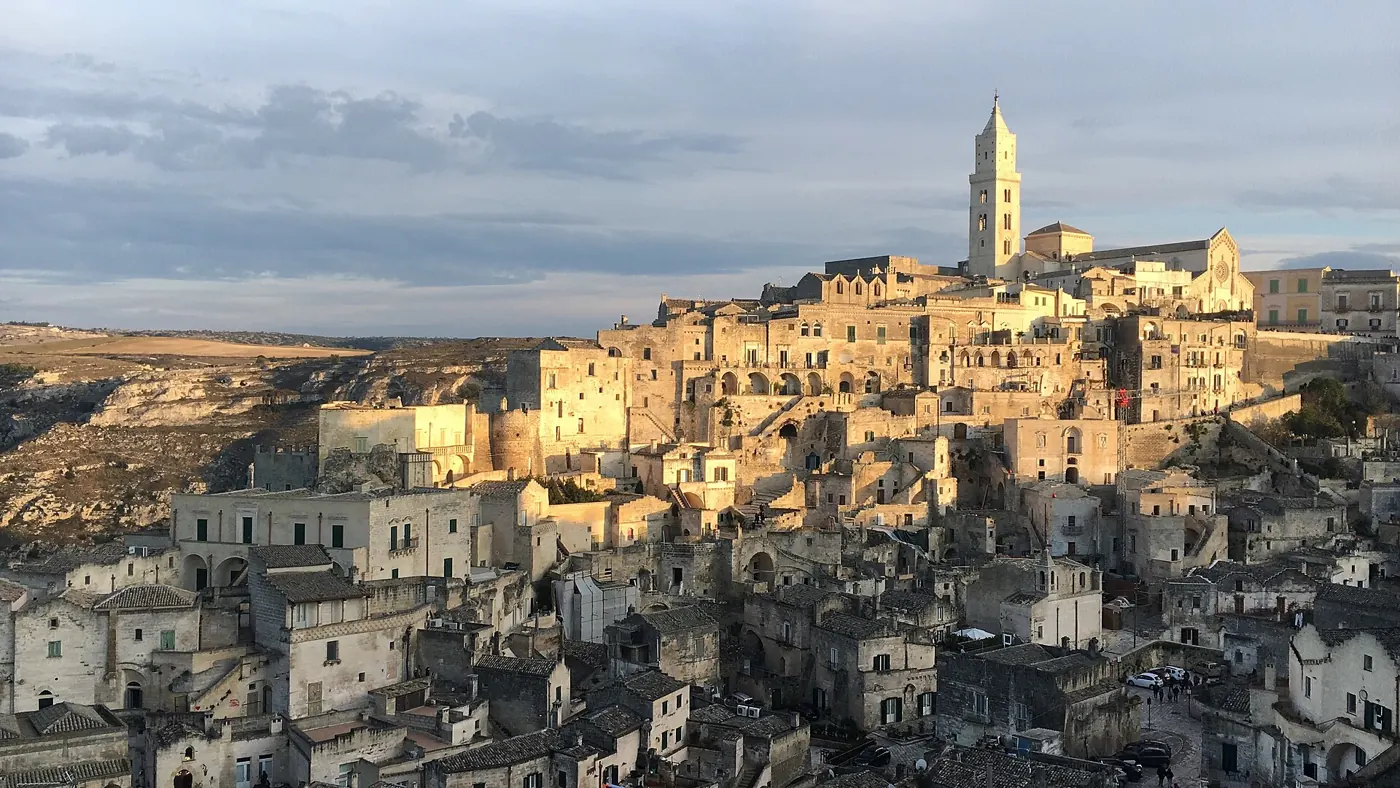
What the Sassi are, in a few lines#
According to the UNESCO entry, the property of the Sassi and the Park of the Rupestrian Churches comprises houses, churches, monasteries and hermitages built into the natural caves of the Murgia, covering 1,016 hectares, with more than a thousand dwellings and many workshops. Occupation goes back to the Palaeolithic and intensifies from the 8th century. There are two Sassi, Barisano and Caveoso, and between them lies the Civita, the first inhabited nucleus, where a Romanesque cathedral was built in the 13th century. Italia.it notes that the site has been a UNESCO World Heritage Site since 1993. The UNESCO entry adds that the entire population of the Sassi was relocated in the 1950s, and that people began to return in the 1980s.
On the date of the evacuation the sources wander: the Ministry of Culture mentions a clearance law of 1952, Lonely Planet Italia says people lived in the Casa Grotta "until 1956", and Italia.it says 1958. UNESCO says only "the 1950s". When you read a precise date, ask where it comes from.
How to get to Matera#
The nearest airport is Bari Palese, 55 kilometres away according to the Comune's tourist portal, which also lists Brindisi (140 km) and Naples (250 km) and a shuttle between Bari Airport and Matera. The shuttle timetable on the portal is dated, so check it before you travel.
Trains hold a surprise. The nearest station on the national network, the same source says, is Ferrandina-Scalo Matera, and from there you continue by road. The direct option from Bari is the FAL (Ferrovie Appulo Lucane) train from Bari Centrale: it stops at Matera Centrale, Matera Sud and Matera Villa Longo. Careful: the FAL station is not inside Bari Centrale; its entrance is at Corso Italia 8. We found no official journey time or frequency, so we do not quote any.
When to go: climate and seasons#
Lonely Planet Italia names spring and autumn as the best seasons, with highs between 15 and 20 °C and little rain, and says winter lets you see the Casa Grotta, the Palombaro Lungo and Santa Maria de Idris without the crowds of the spring bank holidays and summer. Snow, per the same page, usually does not arrive before mid-February, and from December to February highs sit around 9-10 °C.
Here the sources disagree. Lonely Planet writes that winter rain is "practically nil", whereas the Climi e Viaggi climate page makes December the wettest month, with 75 mm over 9 days (November 60 mm over 7 days, October 45 mm over 5). The same page gives average highs of 31 °C in July and 30 in August, and 20 °C in October. In short: summer is hot and busier, spring and autumn are good for walking, winter is quieter but you want a waterproof jacket.
Before you go: shoes, slopes and hours#
The lanes of the Civita, the Comune writes, can only be walked. Paving and steps are part of the route: shoes with a grippy sole, not sandals. Hours change with the season and we are now in autumn: the Casa Grotta, for example, from October to December opens Monday to Friday from 9:30 to 18:00, with last access at 17:40, and Saturday and Sunday until 19:00, with last access at 18:40.
Morning: Sasso Barisano and the Civita#
The Comune di Matera suggests a walking route that starts at the Villa Comunale and goes down via Pentasuglia to via D'Addozio, already inside Sasso Barisano. Here you meet the Monastery of Sant'Agostino, built in 1591 and partly rebuilt in 1747, whose church stands on the ruins of a rock-cut monastery; from the churchyard the view opens onto Murgia Timone and the Gravina canyon. A little further on, the church of San Pietro Barisano has an 18th-century facade over an underground church; according to the Comune's page, last updated in January 2024, the interior is not open to visitors.
From via Fiorentini you climb the Civita, the old heart dominated by the Cathedral. We did not verify the Cathedral's hours or admission: check on the spot.
Lunch break: what to taste#
Italia.it points to three dishes to start with: cialledda (bread soaked with tomato, garlic and olives, hot with egg and bay leaf or cold), Senise crusco peppers, and pignata, mutton slow-cooked in a clay pot with potatoes, tomatoes and soppressata. We name no restaurants because we have not verified any.
Early afternoon: Sasso Caveoso#
From the Civita you descend towards via Madonna delle Virtù, which runs along the edge of the ravine, to the rock-cut complex of Madonna delle Virtù and San Nicola dei Greci, founded between the 10th and 11th centuries, which hosts sculpture exhibitions from July to October. Then you reach Piazza San Pietro Caveoso, with the church rebuilt in 1706 and still used for worship, and Vico Solitario.
The Storica Casa Grotta di Vico Solitario is the clearest place to understand how people lived: the site gives admission at 8 € full and 5 € reduced, including the Neviera, a natural cave and the rock church of Sant'Agostino al Casalnuovo, plus a multilingual audio guide. The Ministry of Culture listing, updated in 2020 and with inconsistent hours on the same page, gives instead 3 € and 2 €: we would not use it as a reference. According to the ministerial entry, the house preserves the hearth, the bed, the stall with the mule's manger and the rainwater collection system, with its channelling and cistern.
End of the day: the viewpoints#
For the classic view of the stone nativity scene, Italia.it recommends the Belvedere of Murgia Timone in the Murgia Materana Park, especially towards evening. The Comune also mentions a Belvedere square reachable by car from the SS 7 Appia towards Laterza. Piazzetta Pascoli, in the centre, is a balcony over the Sassi without going far.
Want a route like this, ready-made and adapting to the weather?
Be among the firstIf you have a second day#
Three ideas with one certain fact each. The Crypt of Original Sin, which Italia.it lists among the rock churches not to be missed, dates from the Lombard period; it can only be visited by online booking, and in October the slots start at 9:30, 11:00, 12:30, 15:30 and 17:00, reduced to four (without the 17:00) from November to February. The ticket office is at the Azienda Agricola Dragone and you must arrive half an hour before. The Palombaro Lungo, under Piazza Vittorio Veneto, is a cistern dug in phases from the 16th century, 16 metres deep, 50 long and holding 5 million litres according to the official site; we did not verify hours and prices. Casa Noha, a short step from the Cathedral, is a project curated by FAI per Italia.it; we did not verify hours or prices.
How to order the day#
- MorningSasso Barisano
From the Villa Comunale along via Pentasuglia and via D'Addozio, pausing at the churchyard of Sant'Agostino.
- Late morningCivita
The pedestrian lanes towards the centre and the Cathedral.
- LunchA Matera dish
Cialledda, crusco peppers or pignata, per Italia.it.
- Early afternoonSasso Caveoso
Madonna delle Virtù, Piazza San Pietro Caveoso and the Casa Grotta, going in before 17:40.
- Late afternoonViewpoint
Murgia Timone or Piazzetta Pascoli, in end-of-day light.
How much it costs, on average#
The only cost we verified is admission to the Casa Grotta (8 €, an indicative average from the official site). For walking through the Sassi along the Comune's route we found no entry ticket on the pages we read. We read no prices for the Crypt, the Palombaro Lungo or the museums, so we do not quantify them. Meals and transport were not verified.
Common mistakes#
- Turning up at the Crypt without a booking: it is online only.
- Arriving at the last minute: you need to be there half an hour before the slot.
- Trusting a single listing for Casa Grotta prices: three sources, three figures.
- Climbing up and down without proper shoes.
- Planning everything on summer hours in autumn.
What to skip#
With only half a day, skip the stops that require booking and keep the Comune's walk with a single visit, the Casa Grotta. The viewpoints cost nothing and remain the best moment.
More itineraries#
To try the same approach in other walking cities, read one day in Lecce or one day in Ortigia. If you are short of time and want a rain plan, there is what to do in Catania when it rains, and for thinking about how to build an itinerary with AI help, itineraries with artificial intelligence.
A route that adapts#
Matera is the kind of place where a wrong opening time or a missed booking wrecks the afternoon. It is the problem UNNIVAI wants to solve: a route of real places that adapts when the day changes. If you want to be among the first to try it, join the waitlist.
Verification note. Data read on 30 October 2026 on the pages listed in the sources: UNESCO, the Comune di Matera and its tourist portal MateraWelcome, Italia.it, the Casa Grotta website and the Ministry of Culture listing, the Crypt of Original Sin website, the Palombaro Lungo website, Lonely Planet Italia and a climate page. Where sources disagree (the Casa Grotta price, the date of the Sassi evacuation, winter rainfall) we say so. We did not verify the Cathedral's hours and admission, Crypt prices, Palombaro Lungo hours and prices, FAL train journey time and frequency, or where to eat. Prices as indicative averages: hours, closing days and bookings change, so always check official information before you set out.
Frequently asked questions
How long do you need to visit the Sassi of Matera?
None of the official sources we read gives a duration. As an editorial estimate, one full day is enough to walk Sasso Barisano, the Civita and Sasso Caveoso with one or two indoor visits; you need two days if you add the Crypt of Original Sin and the museums. The Comune recommends doing the route on foot.
When is the best time to visit Matera?
Lonely Planet Italia names spring and autumn as the best seasons, with highs of 15 to 20 °C and little rain, and winter as the quietest period. A climate page we read gives July as the hottest month (average highs around 31 °C) and December as the wettest (75 mm over 9 days). These are climate averages, not forecasts.
How do you reach Matera without a car?
The Comune's tourist portal lists Bari Palese as the nearest airport, 55 km away, with a shuttle to Matera. By train the FAL line links Bari Centrale with Matera Centrale; the FAL station is not inside Bari Centrale and its entrance is at Corso Italia 8. Ferrandina-Scalo Matera is the nearest station on the national network, and from there you need a road connection.
Can you visit the Crypt of Original Sin without booking?
No: the official site says it can only be visited by booking online, and that you must be at the ticket office half an hour before your slot. Check hours and availability on the site, because slots change with the season.
How much is the Casa Grotta di Vico Solitario?
The sources disagree. The official site gives 8 € full and 5 € reduced, with the Neviera, natural cave and rock church included; the Ministry of Culture listing, last updated in 2020, shows 3 € and 2 €. Trust the official site, which is more recent (edited July 2026), and check at the desk.
Official sources
Be among the first.
Tell me where you want to go: I will write when UNNIVAI reaches your city. No newsletter before that.