
What to do in Catania when it rains: 7 indoor ideas
Keep the stops close, alternate an indoor place with a short outdoor stretch, and check opening hours: museums and monuments change days and time slots. The Achillean Baths, for instance, are listed as open only until 2:00 pm, so they belong in the morning.
- Area
- Historic centre, between Via Etnea and Piazza Duomo
- Duration
- Half a day
- In the rain
- 6 stops out of 7 are indoors
- Indicative costs
- Castello Ursino 6 EUR and Achillean Baths 5 EUR (indicative averages)
- To check
- Opening hours and bookings
In this article
- When does it actually rain in Catania?
- First rule: stay in one area
- 1. Teatro Massimo Bellini
- 2. Castello Ursino and the civic museum
- 3. Monastery of the Benedictines of San Nicolò l'Arena
- 4. The Cathedral of Sant'Agata
- 5. The Achillean Baths under the Cathedral
- 6. Lunch at the fish market, but under cover
- 7. A proper coffee break
- How to order the day
- What it costs, on average
- Common mistakes
- What to skip
- Getting there
- If you have another day
- Plan B is built beforehand
In Catania rain does not ruin the day: it moves it. The historic centre is compact, distances between stops are short and many of the most interesting places are indoors. You only need a sensible order, so you do not cross half the city in the downpour.
When does it actually rain in Catania?#
Rain is not spread evenly through the year. One climate page we read lists 7 rainy days in October, 5 in November and 8 in each of December and January, against 1 in June and 1 in July. A second page with a rainfall table puts October at the top with 84 mm, followed by September with 77 mm, and gives a yearly total around 600 mm; the same page, however, says in its text that November is the wettest month, so read the numbers as orders of magnitude. The practical message is simple: from October to January an indoor plan is not an exception, it is part of the trip.
If you travel in those months, do not build a day around a single outdoor activity. Plan two interchangeable half days: one for sun and one for rain. The rainy one is this page.
First rule: stay in one area#
The worst route in the rain is the one that jumps from one end of the city to the other. Pick one area and fill it: the stretch between Via Etnea, Piazza Duomo and the fish market is the most comfortable, because everything is a few minutes on foot.
Try it
1. Teatro Massimo BelliniIndoors#
The theatre named after Vincenzo Bellini is one of the city's landmark places, right in the centre. According to Italia.it it opened on 31 May 1890 with Bellini's Norma, and guided tours can be booked. Tour times and prices do not appear on the pages we opened, so ask the theatre. Mind the address: Italia.it gives Via Giuseppe Perrotta 12, while another source places the theatre on Piazza Vincenzo Bellini. The two do not match, so trust your map and the theatre's own website.
2. Castello Ursino and the civic museumIndoors#
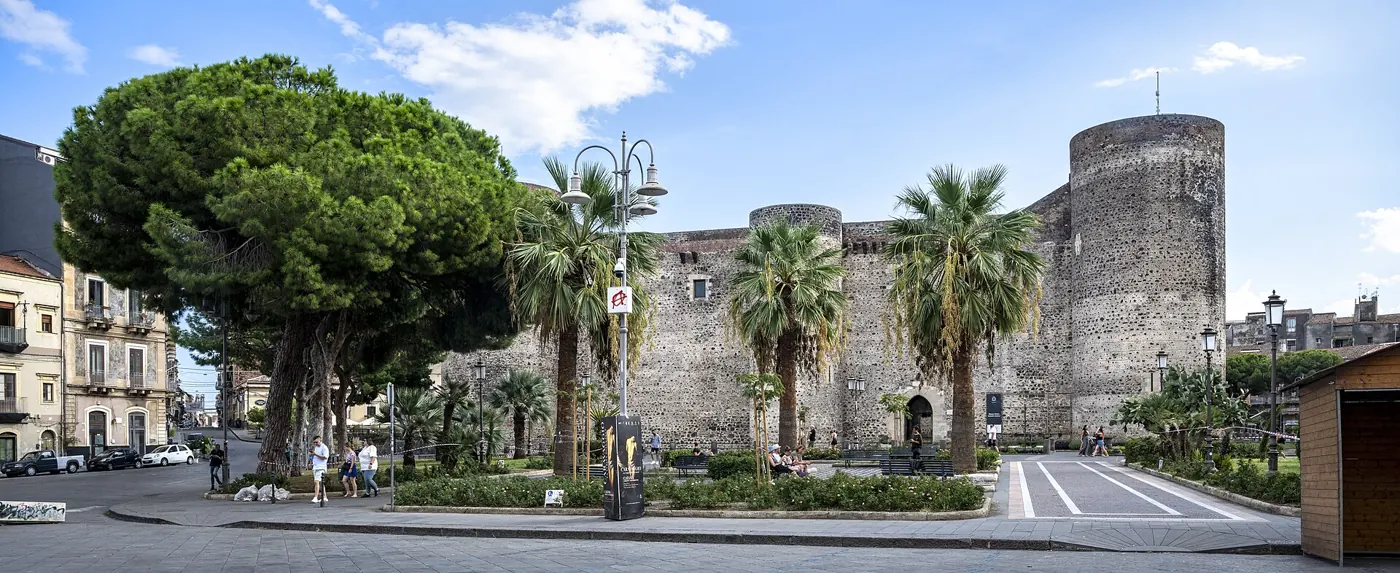
The Swabian-era castle was built between 1239 and 1250 under Frederick II, and the civic museum has been inside it since 1934. Volcanic activity and earthquakes mean it now stands about a kilometre from the sea. The Ministry of Culture page lists it open 9:00 to 19:00 every day, ticket office until 18:00, a full ticket at 6 EUR (indicative average) and no booking required. The courtyard, ground floor and first floor are open, but only part of the collection. Inside you find a painting gallery, Hellenistic and Roman finds, Greek vases, coins and medieval portals. One caveat: the English Wikipedia infobox says the castle is not open to the public, which contradicts both its own text and the ministry page. Sources disagree, so phone ahead, especially off season. It is a solid stop for an hour or two.
3. Monastery of the Benedictines of San Nicolò l'ArenaIndoors#
One of the great monastic complexes in Europe, now home to the Humanities Department of the University of Catania, at Piazza Dante 32. The pages we read date it to the mid-16th century (one says 1558) and mention the restoration by architect Giancarlo De Carlo. On the UNESCO side: according to the World Heritage listing page we read, Catania is one of the eight Val di Noto towns inscribed in 2002. Guided visits have been run over the years by Officine Culturali, with booking recommended, but the information we found on times and prices is dated, so we do not repeat it. If it rains, decide early in the morning and call.
4. The Cathedral of Sant'AgataIndoors#
The Duomo faces Piazza Duomo, with the Elephant Fountain and the Liotru, the symbol of the city. According to Museionline it is open daily from 10:30 to 17:30 with free entry, though the same page advises confirming the hours. It was built in the Norman period, destroyed by the 1693 earthquake and rebuilt by Giovanni Battista Vaccarini between 1733 and 1761. Inside you find the tomb of Vincenzo Bellini and, in the sacristy, a fresco of the 1669 Etna eruption. The interior is a perfect shelter for a break between two outdoor stretches.
5. The Achillean Baths under the CathedralIndoors#
In the basements of the Duomo area there are Roman-era rooms, dated to the 4th-5th century. Only a small part is visible: a central room with cross vaults on four pillars and a barrel-vaulted corridor. The Museionline page lists Monday to Saturday 9:00-14:00, Sunday by reservation only, 5 EUR for the baths alone (indicative average; the page also lists combined tickets), and recommends confirming by phone. Access is by a short staircase, so this is not a step-free place. A page on the Duomo mentions a door on the right side of the facade. It is the classic stop you do not know you want until it rains: dry, unusual and very close to the centre.
6. Lunch at the fish market, but under coverOutdoors#
The fish market is the popular heart of Catania, mostly outdoors and in the morning. When it rains, the answer is to arrive early and sit down in one of the covered places nearby, instead of walking between the stalls. For hours and how the market works, read our guide to the Catania fish market; for what to order, what to eat in Catania.
7. A proper coffee breakIndoors#
In Catania an hour's pause between two stops is not wasted time: it is the best way to let the storm pass. Pick a café close to your next stop, not to where you started.
Want a route like this, ready-made and adapting to the weather?
Be among the firstHow to order the day#
The real constraint is not the rain but the clock: the Achillean Baths close at 2:00 pm, the Castello ticket office at 6:00 pm. The Duomo, open from 10:30, sits in between. This order works for most wet days:
- MorningAchillean Baths and Duomo
The Duomo from 10:30, then the Baths before 14:00: they are close, under the same roof.
- NoonLunch nearby
Stay where you are, with no moves in the rain.
- AfternoonCastello Ursino
One or two hours indoors, ticket office open until 18:00. Alternatively the Monastery, if you booked.
- EveningShort walk
If the sky opens, a stroll through the centre towards Via Etnea.
What it costs, on average#
Using only the prices we found on the pages, a route with Castello Ursino (6 EUR) and the Achillean Baths (5 EUR) comes to about 11 EUR per person, indicative averages. The Cathedral is free according to the page we read. Add lunch and coffee, which we did not verify and so do not quantify. Reductions: the Castello page lists none; the Baths page lists combined tickets as well, so ask at the ticket desk.
Common mistakes#
- Arriving at the Baths after 2:00 pm and finding them shut.
- Assuming everything is open on Sunday: the Baths are by reservation only.
- Trying to do everything in one afternoon. Three real stops beat seven rushed ones.
- Walking in smooth soles on wet lava paving.
- Trusting a single website: as you saw above, sources can disagree even on something as simple as whether a place is open.
What to skip#
If you are short on time, skip the Teatro Bellini as a visit: without verified hours and without a booking it is the least predictable stop. Keep it for a day with a free evening, when an opera or a concert is a ready-made indoor plan. If you have already seen the Duomo, Castello Ursino alone carries an afternoon.
Getting there#
The main stops are all in the centre. Castello Ursino is on Piazza Federico II di Svevia, the Duomo on Piazza Duomo, the Monastery on Piazza Dante. We did not verify exact distances or city bus lines, so open your map and check the shortest route before you step out: in the rain every extra block is felt.
If you have another day#
Catania's centre fits in half a day: for a full day, see Ortigia on foot, without rushing, a little over an hour away. And if you like thinking in plan Bs, read how to use artificial intelligence for itineraries.
Plan B is built beforehand#
The problem with rain is not the rain: it is having to rebuild the programme from scratch, in the downpour, with your phone in your hand. It is the same problem UNNIVAI wants to solve: a route of real places that adapts when the day changes. If you want to be among the first to try it, join the waitlist.
Verification note. Data read on 29 October 2026 on the pages listed in the sources: the Ministry of Culture page for Castello Ursino, Italia.it, Museionline, Wikipedia, a World Heritage listing page (unofficial site) and two climate pages. Where sources disagree (whether Castello Ursino is open, the Teatro Bellini address, the wettest month) we say so. We did not verify the hours and prices of the Monastery and the theatre, nor the accessibility of the Castello. Prices are indicative averages: opening hours, closing days and bookings change, so always check official information before you set off.
Frequently asked questions
Does it rain a lot in Catania?
Rain falls mostly between autumn and winter and often arrives in downpours. One climate page we read lists about 7 rainy days in October and 8 in each of December and January, against 1 in June and July: treat these as orders of magnitude, not a forecast. It is worth having an indoor plan B for half a day instead of cancelling everything.
Can you explore Catania's historic centre in the rain?
Yes, but wear the right shoes: the lava paving gets slippery. Alternate short outdoor stretches with indoor visits that are close to each other, instead of crossing half the city.
How long do these stops take?
Two or three indoor stops fill half a day without rushing. A reasonable guess is one to two hours for Castello Ursino and under an hour for the Cathedral plus the Baths: these are our editorial estimates, not official visit times.
What is open on a Sunday?
It depends. The Ministry of Culture page lists Castello Ursino as open every day, while the page we read for the Achillean Baths lists Monday to Saturday and Sunday by reservation only. Always check before you go.
Are the stops accessible for people with reduced mobility?
We found no verified accessibility information for Castello Ursino. The Achillean Baths are reached by a short staircase according to the page we read, so they are not step-free. Call ahead if it matters.
Official sources
Be among the first.
Tell me where you want to go: I will write when UNNIVAI reaches your city. No newsletter before that.