
UNNIVAI / Blog / Polignano a Mare
Polignano a Mare without a car: train, on foot, what to see
You reach Polignano a Mare easily by regional train on the Bari-Lecce line and everything else is on foot: the Arco Marchesale, the old town, Lama Monachile and, if you like, the roughly 40-minute coastal walk to San Vito. The Pascali museum opens only in the afternoon and only Wednesday to Sunday. For train times and fares always use the Trenitalia site: the frequency and price figures in this guide come from third-party sites.
- Area
- Polignano a Mare, on the Adriatic coast about 33 km south of Bari
- Duration
- Half a day or a full day, all on foot from the station
- Indicative budget
- Regional train around 4 € each way (aggregator average) and the Pascali museum 5 €; the rest of the walk is free
- Getting around
- Train to the station, then old town, Lama Monachile and the seafront on foot
- To check
- Train times for your day, winter museum hours and the state of the cliff paths
In this article
- How do you get to Polignano a Mare without a car?
- How many trains are there and what do they cost?
- What about from Bari airport?
- What to do on arrival: the Arco Marchesale and the old town
- Lama Monachile: how to get down and when to go
- Caves and the Grotta Palazzese: what is known and what is not
- The Pascali foundation: contemporary art
- The walk from Polignano to San Vito
- What to eat without booking a table
- Common mistakes in Polignano without a car
- Plan B if the weather changes
- What to spend (indicative averages)
- If you have more time
- If your day changes
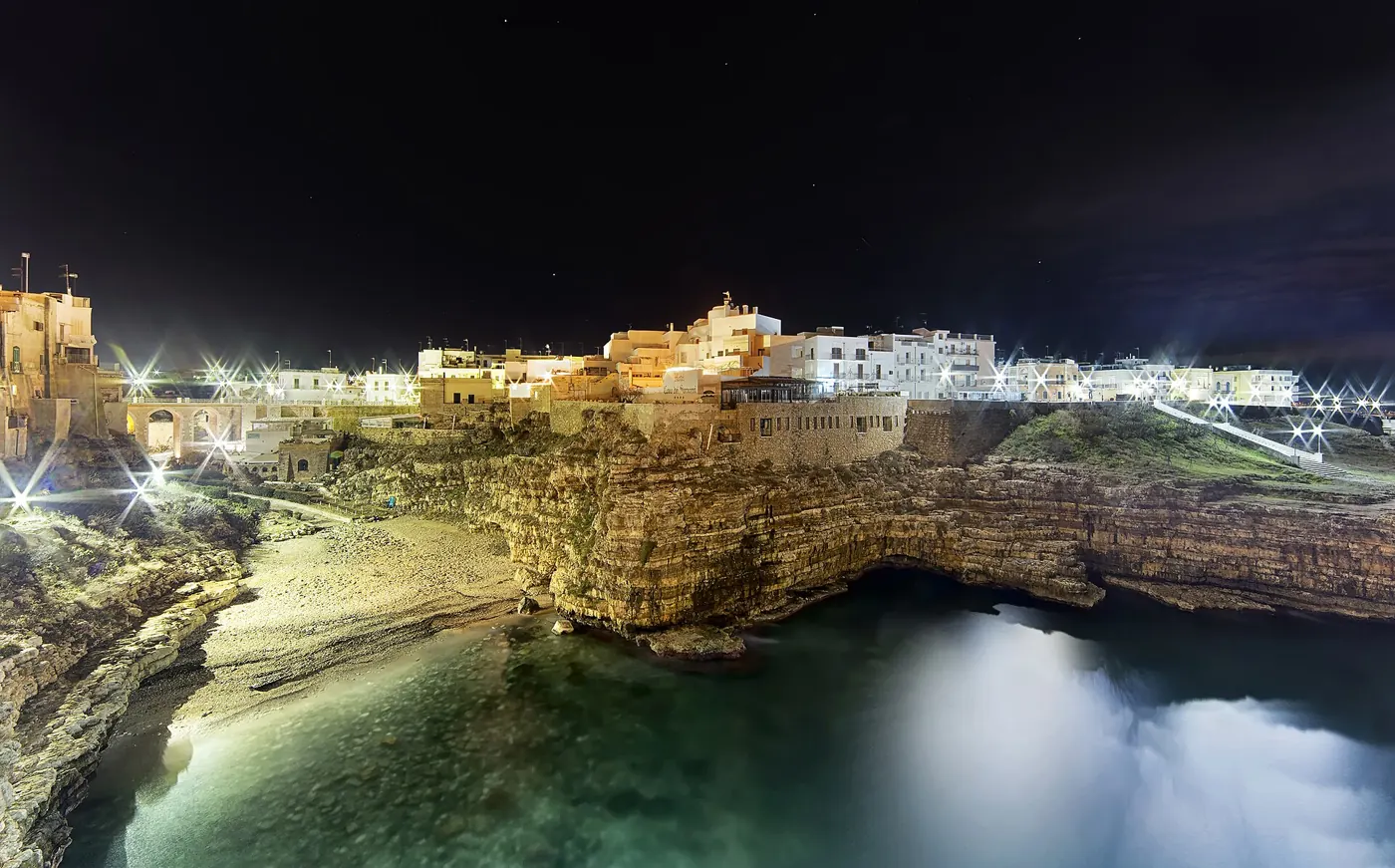
Polignano a Mare is made for people who arrive on foot: a white old town on the cliff edge, a small cove squeezed between the rocks and a seafront path that reaches almost to Bari. You do not need a car here. This guide puts in order how to get there by public transport, what to do once you step off the train, and which facts we honestly could not verify.
How do you get to Polignano a Mare without a car?#
The town is about 33 kilometres south of Bari on the Bari-Lecce route and borders Mola di Bari, Conversano, Castellana Grotte and Monopoli, according to the Italian Wikipedia entry. The station is on the Adriatic railway, the line linking Bari and Lecce: the Italian Wikipedia says it is served by regional trains and some long-distance ones. It has three tracks, the first for trains from Bari towards Lecce, the second for the opposite direction and the third for passing. The English Wikipedia page adds that Trenitalia runs the regional service, RFI owns the infrastructure, and the station opened in 1865.
One limit to state at once: none of the pages we read gives the distance between the station and the old town, so we do not say how many minutes the walk takes. The practical advice is to check the map before you travel and decide whether the walk suits you with luggage.
How many trains are there and what do they cost?#
For numbers we had to rely on a travel aggregator, which is not an official source and should be treated with caution. The Omio page for Bari to Polignano a Mare listed, for the date searched, about 34 trains a day and an average fare of 4 € for the regional train; the Intercity listed cost 9 €. On duration the same page gives two figures that do not quite match: it speaks of 34 minutes on board as an average, but for the listed runs it says between 17 and 28 minutes. We report both and tell you we do not know which better describes your train: look at the timetable for your day.
Also from that page, and only as a sample for a single date, the first listed departure was at 5:02 and the last at 20:40. These are not the "usual" hours, just a sample. The Trenitalia regional pages we opened say something useful for families: in Puglia children up to ten (not yet ten) travel free with an adult holding a valid ticket, and from ten there are no age-based discounts.
There is also the bus. The same aggregator lists Ferrovie del Sud Est runs of 40-45 minutes, from 3 €, with the first of the sample at 12:10 and the last at 20:00. For an early start, then, the train is the easier choice.
What about from Bari airport?#
The Rome2rio route comparison, again an estimate and not a timetable, lists as fastest the train from the airport to Bari Centrale and then a change for Polignano, in about 1 hour 27 minutes, at 10 to 14 dollars (the page uses dollars). As alternatives it offers city line 16 to Bari Centrale and then a bus, in about 2 hours 40, or line 16 plus the train, in about 2 hours 6. Driving is given as about 40 minutes and a taxi as 40 minutes too, at a much higher cost. The Trenitalia page about the airport gives no frequencies or times: it only confirms there is an airport connections section and that digital regional tickets can be bought.
What to do on arrival: the Arco Marchesale and the old town#
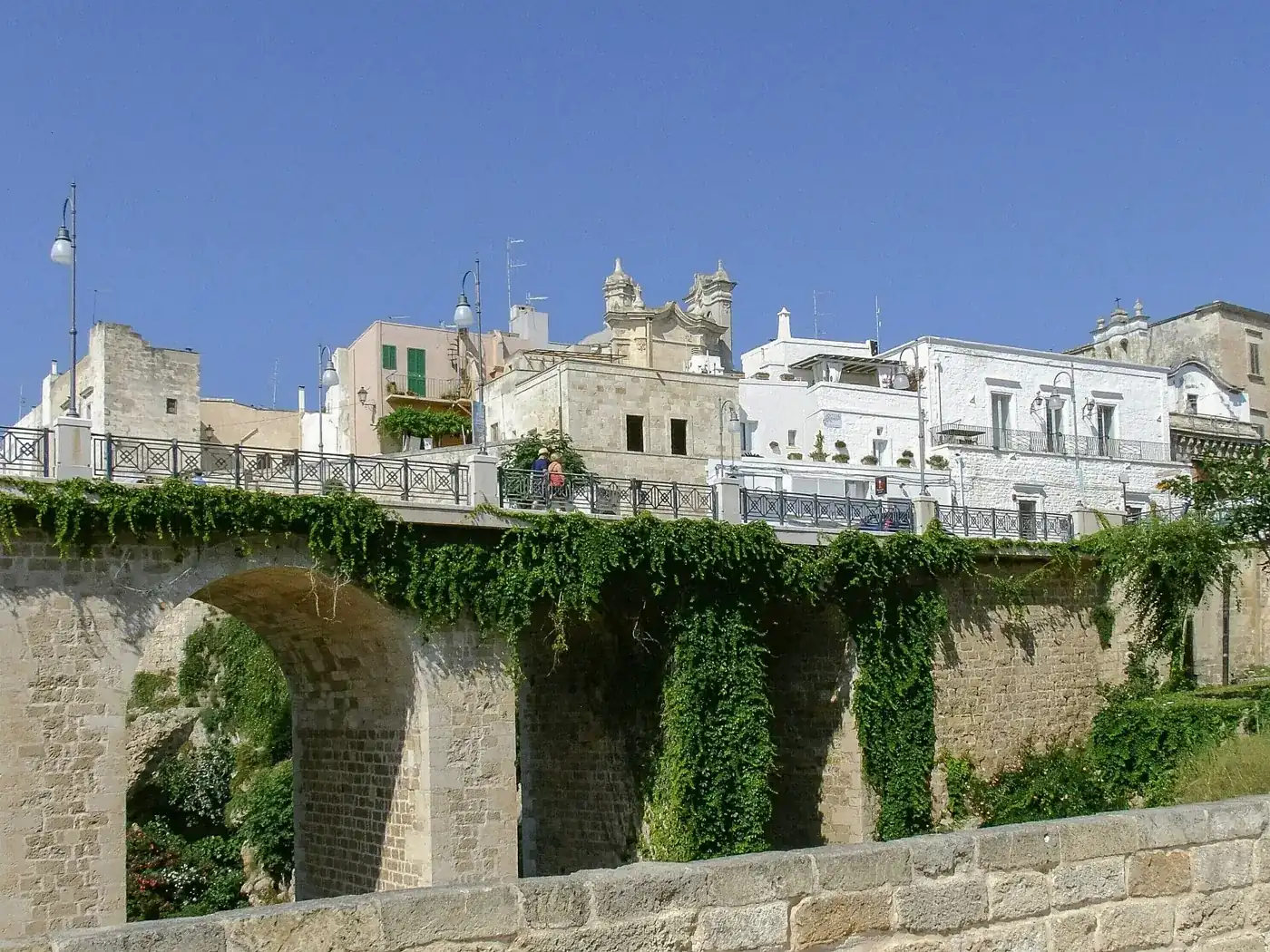
From the station you walk towards the sea and the old town. According to Italia.it, the official tourism portal, the old town is a maze of narrow lanes of white houses of medieval origin built on the cliff, and the traditional entrance is the 16th-century Arco Marchesale, or Porta Grande. Until 1780 it was the only way in: the town was surrounded by a moat with a drawbridge. Inside are the 13th-century Chiesa Matrice, the Palazzo Marchesale and the Palazzo dell'Orologio.
The best approach is to have no plan: the lanes are few and short, and they bring you back to the edge of the rock anyway. Look for the viewpoints, where the town ends and the drop over the sea begins.
Lama Monachile: how to get down and when to go#
Lama Monachile is the cove cutting through the cliff and, per Italia.it, the most photographed spot in town, very crowded in summer. The bridge above it stands on a Roman bridge on the Via Traiana, the Rome-Brindisi road; the Wikipedia entry adds that it can still be walked and was restored in 1997. The name, again per Wikipedia, recalls the old presence of the monk seal. On the seafront there is also the statue of Domenico Modugno, born in Polignano and author of "Nel blu dipinto di blu".
To reach the beach, a beach guide, Spiagge.it, lists two routes: the stone staircase under the Roman bridge, more direct and scenic, and the path near the Bastione di Santo Stefano, gentler and less steep. The beach is pebbles, so wear comfortable shoes; for reduced mobility the Bastione path is the least steep option, but the same source warns there are no walkways down to the water. On timing, the guide recommends June and September, with July and August the busiest, and to avoid crowds early morning before 9, late afternoon after 5 pm and weekdays. Rough sea, it adds, makes swimming harder: watch the flags.
Keep in mind these seasonal hints come from a private guide, not from a local order. The Municipality's home page, which we opened on 2 November 2026, had nothing on access to the cove, parking or tourist shuttles: if you need an official rule, ask the Comune (phone on the home page: +39 080 4252300).
Caves and the Grotta Palazzese: what is known and what is not#
Italia.it notes that about twenty sea caves open along the coast, the largest being the Grotta Palazzese. The palace above it is now a five-star hotel with its restaurant carved into the natural cavities, and the cave can still be reached by sea. We give no prices or hours: we did not read them on an official source and we name no venues. If you want to see it up close without a car, the experience is by sea, and the terms must be asked of whoever runs it.
The Pascali foundation: contemporary art#
A stop people often skip. The Pino Pascali municipal museum of contemporary art is in the former municipal slaughterhouse, at Via Parco del Lauro 119, near the southern seafront. According to the Ministry of Culture listing it is open Wednesday to Sunday, 4 pm to 8 pm, closed Monday and Tuesday, with no booking required; the full ticket is 5 € and reduced 2.50 €. The museum opened in 1998 with a retrospective of Pino Pascali, born in Polignano in 1935. Mind the listing date, last updated in September 2022: winter hours and current exhibitions need rechecking. Italia.it, for its part, places the foundation on the opposite side of town from the old centre and says it hosts contemporary art shows.
The walk from Polignano to San Vito#
If you have half a day left, Italia.it describes a walk of about 40 minutes along the coast towards Bari, past the coves of Ponte dei Lapilli and Porto Cavallo, to San Vito. There are the ruins of a 10th-century abbey and a square tower; the village is known for bars and restaurants. It is a good car-free option: 40 minutes out, a meal or a coffee, and back at an easy pace. Check the last train before you go and leave a margin for the return, because on foot time runs faster than you expect.
Want a route like this, ready-made and adapting to the weather?
Be among the firstWhat to eat without booking a table#
Again per Italia.it, the dishes to look for are raw seafood and riso, patate e cozze (rice, potatoes and mussels). There is also a local carrot, the carota di Polignano, grown near the San Vito abbey and a Slow Food presidium. Among drinks it cites the caffè speciale: sweetened coffee with lemon peel, cream and amaretto, served in a small glass. We name no venues, because no source we read did, and suggest you pick a place where you see locals sitting.
Common mistakes in Polignano without a car#
- Assuming a train time: the figures we found are a sample from a third-party site, not an official table.
- Turning up at the Pascali museum in the morning: it opens only in the afternoon, and is closed Monday and Tuesday.
- Going down to the beach in light footwear: it is pebbles and the paths are steep.
- Counting on a quiet beach on the busiest summer days: beach guides list July and August as the peak.
- Leaving the return to the last minute: if you walk to San Vito, count the way back too.
Plan B if the weather changes#
In rough sea the beach guide notes that swimming becomes harder, and in rain the walk down to the beach makes less sense. On those days lean on the old town, the Pascali museum (from 4 pm, Wednesday to Sunday) and an indoor break. For another walkable Puglia day on the same logic, read one day in Lecce.
What to spend (indicative averages)#
For an adult the cost of a car-free day is low: about 4 € each way for the regional train according to the aggregator, so around 8 € return, plus 5 € if you add the Pascali museum. These are not official prices and depend on the train and any discounts; they do not include food, so we give no figures.
If you have more time#
For another walkable southern town, see Matera and the Sassi, where timing matters as much as in Puglia. For another coast without a car there is Cinque Terre on foot; for a city to eat through in one day, Bologna. If you wonder how to use AI to plan without made-up hours, read AI travel itineraries: what works.
If your day changes#
UNNIVAI is built to rewrite the route when the weather, train time or tiredness change: same walk, different order. If it sounds useful, join the first people in.
Hours, prices and opening days were read on the sources listed and checked on 2 November 2026; they change during the year: check before you go. Where sources were not official or disagreed we said so; we could not verify the station-to-centre distance, whether there are traffic-restricted zones or shuttles, official train timetables, or how to see the caves from the sea.
Frequently asked questions
Do you need a car to visit Polignano a Mare?
No. The station is on the Bari-Lecce line, served by regional trains and some long-distance ones, and the old town, Lama Monachile and the seafront are all on foot. A car only helps if you want to go inland.
How do you get from Bari to Polignano a Mare by train?
On a regional train on the Adriatic Bari-Lecce line. A travel aggregator lists about 34 trains a day, 17 to 28 minutes for the listed runs and an average fare of 4 €. That comes from a third-party site: check the day's timetable on the Trenitalia site.
How do you get there from Bari airport?
A route comparison lists as fastest the train from the airport to Bari Centrale and then a change towards Polignano, in about 1 hour 27 minutes. It is a third-party estimate, not an official timetable.
When is the best time to go to Lama Monachile?
A beach guide recommends June and September for milder weather and thinner crowds, while July and August are the busiest. To find it quieter it suggests early morning (before 9), late afternoon (after 5 pm) and weekdays.
Is the Pino Pascali museum open?
According to the Ministry of Culture listing it is open Wednesday to Sunday from 4 pm to 8 pm, closed Monday and Tuesday, with a full ticket at 5 € and reduced 2.50 €. The listing dates from 2022: confirm before you go.
Official sources
Be among the first.
Tell me where you want to go: I will write when UNNIVAI reaches your city. No newsletter before that.